Showing posts with label 303. Show all posts

Wednesday, November 16, 2011

Lesson Plan Response #2

                 It took my partner and I a while to think of a great idea for a lesson that only lasted 45 minutes. Nick and I knew that we wanted to base it off our "Representations of Home" presentation that we gave to the class a few weeks prior. After a meeting with our professor, he challenged us to make something 3-dimentional. We focused on the amazing art of Pepon Osorio and Gregory Crewdson and talked about how they represent a feeling of home in their works. After briefly discussing what the feeling of "home" could mean without being in a space of continuous living, we got the feeling that this would be a great idea for a lesson. By talking about what the "home" feeling is to some students, we could translate that same feeling into a different space.
My very first example, we were still working out the kinks with the sizes.
                 What we ended up making was a small 3-d box with a writing exercise that got the students' juices flowing. After briefly recapping the ideas we saw in the powerpoint presentation, I brought up the idea we wanted to use for our boxes. I was hoping for a bit more of a pre-creation discussion about the ideas and objects the students were going to use, but the class seemed pretty quiet and tired during our lesson. After realizing the questions I was asking was not sparking any interest, I looked at Nick and he immediately jumped into the lesson itself. I thought perhaps he could have rephrased the questions or gone about it differently, but what he did allotted the most time for the actual creating of the box. We then asked the students to write down some words, phrases or sentences that reminded them of their certain place. By having them write about the feeling and memories they have of this place, students easily reference their writing to make their 3-d box a bit more meaningful. While doing the lesson, we realized that we had completely forgotten to grab scrap paper for the writing prompt.. and quickly improvised by having the students use the back. It's interesting to note that Meghan pointed out how we should have had scrap paper instead because it was too distracting to have it all written on one piece of paper. As soon as Nick called the students to watch the folding demo, I immediately thought that they could have watched a demo from their desks, but he continued to give the step by step. I also noticed his assumption that everyone in the room knew how to make a “pop-up” but this was a part of my demo time and it made me a bit upset that he tried to completely skip it. When we sent students back to their desks to continue working, I walked around and made sure they were on the right track. For those who looked confused by the assignment, I tried asking questions like... “where do you feel most comfortable, if not at your house?” and “What is your favorite place to go with friends?” Mary told me that she messed up her paper, but she really just wanted to see if we had extras drawn out (which we did!) Marissa acted like a distraught student who did not like being at her house. I used some of the previously stated questions with her to which she answered each one with a shrug. After a while she wasn't giving me anything to work with so I told her, “if it's that hard, take some extra time to think about it, maybe next time you see your friends you will know.”
Rachel D's example! Great job, Rach!
I think the lesson itself went pretty well. We carefully decided who was going to say what, and although the roles were not as clean cut as the lesson we did at our fieldwork, I still think it was equal on paper. With that being said, it was still difficult for me to get a word in. What I wanted or planned to say was often already being explained by my partner which made my role during the lesson a bit uncertain. He sometimes interrupted my thoughts and kept going off in another direction than I had already planed. I know this is not really his fault, but our teaching styles are too different which makes it hard to teach in pairs. I figure when it comes time to student teach, I should be able to really take control of my classroom (or let's hope).

Thursday, November 10, 2011

Tim Lefens Visit

I took Art for the Exceptional Child last semester, and it was here that I learned about the great things that Tim Lefens was doing. I know they had a hard time getting him to come but it finally happened and was a really enjoyable lecture to listen to. He was a very personable speaker and brought a great sense of energy to the podium. Some of the stories he told were really funny which made it easy to pay attention and take something useful from it all.

He began by explaining what inspired him to do art. The notion of limitlessness was his main aspiartaion. He quoted DiVinci saying "Body and spirit cohabitate against our wills, the body longs for the Earth, the spirit longs for the sky." I think by starting with this, we really know where his art comes from. He said that artist find real art only after letting go of themselves. I think this is so true, he was right in saying that not all fine art is good art.. only those artist who completely lose themselves in what they are doing, have potential to really impact viewers. He said that real art exceeds among the plateau, where there is a feeling of equality among artists, and strives to  ascend beyond that physical level. The best art speaks to the viewer... it hits home and evokes a strong sense of emotion. I agree with him fully on this idea. I'd like to think that some of my artwork does that for someone.
Lefens' belief that the conceptual aspects of art is not as important as the emotion that it evokes. If art has to be explained, it cannot be as powerful as just looking and knowing. For the making of it all, if it is planned it cant be as strong as losing oneself in the art-making and therefore making that ascend beyond the averages.

After religiously being taught to think of a "Big Idea" within my curriculum, I find Lefens' ideas are constrastive. The lessons we create start with a concept as to allow our students to create something with more meaning. But though students might not particularly grasp this idea, I feel like
 it may not be necessary for them to lose themselves within the making of the work. They want to do what is right, and what we, as teachers are looking for. Following a concept may or may not lead them into the art-making that Tim Lefens deems most note-worthy. In my own art-making, I try hard to think of a conceptual idea often, but sometimes... it just has to look nice. I might end up making something with no higher value to it, but it was the process of making that moved me most and if i like the result product, than it is deemed worthy of my own standards. So much attention is placed on being conceptual, especially at this school... but it is not the only way to produce something with meaning. It is, however a good way to motivate students to make something more meaningful which can result in the artist "losing themselves" in the art-making.


"If someone has to tell you it's art... it's not art."

Lesson Plan Ideas/Reflection

My partner, Nick and I have been trying to conjure an idea based off our "Representations of Home" presentation that we gave to our class a few weeks ago. We focused on the amazing art of Pepon Osorio and Gregory Crewdson and talked about how they represent a feeling of home in their works. Osorio usually uses concepts linked to nationality and feelings of displacement. Whether this be having to live in a culture different from one's own, or having to move out due to a fire... his themes of displacement can be reckoned (as seen below in "Tina's House").

Pepon Osorio's "Tina's House"
On the other hand, Gregory Crewdon's work has a dramatic and cinematic view of everyday American small towns. He photographs images on a huge large-scale set that he plans out very carefully to capture the desired image.
Gregory Crewdon's "Ophelia"
 
After briefly discussing what the feeling of "home" could mean without being in a space of continuous living, we got the feeling that this would be a great idea for a lesson. By talking about what the "home" feeling is to some students, we could translate that same feeling into a different space.
We were originally going to use a mixed media/collage/drawing on a flat sheet of paper... but this idea was pretty lame and after discussing it with our teacher, he challenged us to make it 3-d. What we ended up making was a small 3-d box with a writing exercise that got the students' juices flowing. By having them write about the feeling and memories they have of this place, students can easily reference their writing to compose a meaningful 3-d box. It was really hard to think of something that could be done in 45 minutes, but in the end, the students really had fun with it.

Here is Rachel D.'s example...

I even enjoyed making the teacher examples, which is always a good sign.


I think the lesson itself went pretty well. Though Nick and I planned what each of us was gonna say, I found myself unable to get a word in. After I finished what I was explaining, Nick would take over and just kinda keep talking. I know this isn't really his fault... and it wasn't on purpose... but our teaching styles are just too different which makes it hard to teach in pairs. I figure when it comes time to student teach, I should be able to really take control of my classroom (or let's hope).

Tuesday, September 13, 2011

Response to A Middle School Cirriculum

J Bean's A Middle School Curriculum provided me with great insight in what I should expect when teaching early adolescents. Because I was a part of this demographic about a decade ago, I can still recall the awkwardness that was middle school. All the girls matured way faster than their male counterparts, and ended their growth in height, whilst the boys had yet to fully "sprout." Braces, glasses, and pimples were all a huge part of our everyday concerns, but in actuality it was only because they were focused upon in our peer groups, or scrutinized by our enemies. After a year of being picked on in upper-elementary school, middle school was prime time for me to make new friends. The acceptance into a peer group was something I strived towards. I found a great deal of comfort in my middle school art room and it was there I made and kept a good number of my friends. Our teacher gave us a great deal of freedom after realizing how much we wanted to spend time in the art room. We were the first year she created Art Club! (this was in 2002ish?) The search for my own sense of well-being came easily with such positive artistic experiences. It was here I learned of my love for art.
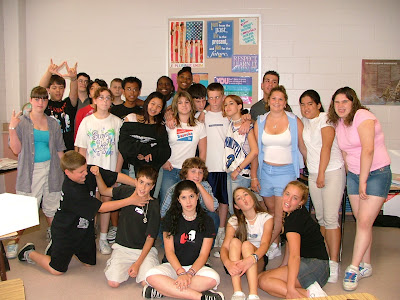
My 8th grade unofficial class picture - the silly version
I feel like identity search is a fundamental part of this time in one's life. Self- esteem, self concepts, and self-perceptions can greatly influence the way one acts in certain social situations. I feel that this can be a fun way for art educations to en corporate a unit on Identity into their curriculum. Though they may not know what they want to be when they grow up, or where they're headed in life... these ideas can be explored in the art room, to possibly nudge them in the right direction as it did for me.

The article talks about how students are often experiencing many adult-like situations. Whether it be at home, in school, on the streets, or with their friends, these children are learning how to be adults. Not only are middle schoolers going through tough physical growth, but they are growing intellectually and socio-emotionally as well. Slowly, they are learning how to be (small) members of their communities. They are working hard to get through this awkward time in their lives, which I'm sure causes many teachers to think of them as just "kids." Kids, perhaps, but kids who are dealing with the same issues as adults.

By addressing the social and personal concerns of early adolescents, teachers can incorporate adequate themes into their curriculum that will enable self discovery and growth in their classrooms

This is a link to a clip from a Nickelodeon show called "Ned's Declassified School Survival Guide" regarding bullies. There was no embed code, nor a clip on youtube but the whole show is a great example of the issues kids undergo during their middle school years.

Tuesday, September 6, 2011

Surrealist Collage

Surrealism allows for students to think outside of society's social "norms" and create images that can represent a dream-like world in connection to every-day life. By using magazines or books or other found pictures, students collect images that may or may not share a connection. While choosing these images, students can cut them out, and play with their locations on the paper in front of them. A conversation about collage artists who create dream-like, illusionist, and bizarre new pictures from already-existing images will ensue in the classroom.
Using Dada collage artist, Hannah Hoch as a prime example in the classroom, I would introduce my students to the idea of a collage-based surrealist game. We could talk about why these images seem dream like, and where the originals may have come from. For example, Hannah Hoch's piece above is a collision of eyes.  What is she trying to say about these eyes? Why did she arrange them in that certain way? What do the colors/patterns behind the eyes tell you about her over-all choice to arrange them in such a way? This sort of discussion will get the students to think about how they can incorporate their own drawings into an image.
When working with each other, students could explore the many ways in which their drawings can be incorporated into their collages. I came up with my own Surrealist game to go with this lesson, considering the article did not suggest a game on this topis. I would have my students split into groups of 3-5 and work on a collaborative "Pass the Paper" drawing. The first student would take 15 seconds to draw whatever he/she wanted and then pass it to the next student who, after looking at the previous drawing, would continue in their own way. The circle continues and the drawing evolves. This teaches the students to draw from a previous image and alter it with their individual creativity.

Example: